
November 1, 2026
Military Uniforms Explained: Every Type of Army, Navy, Marine and Air Force Uniform
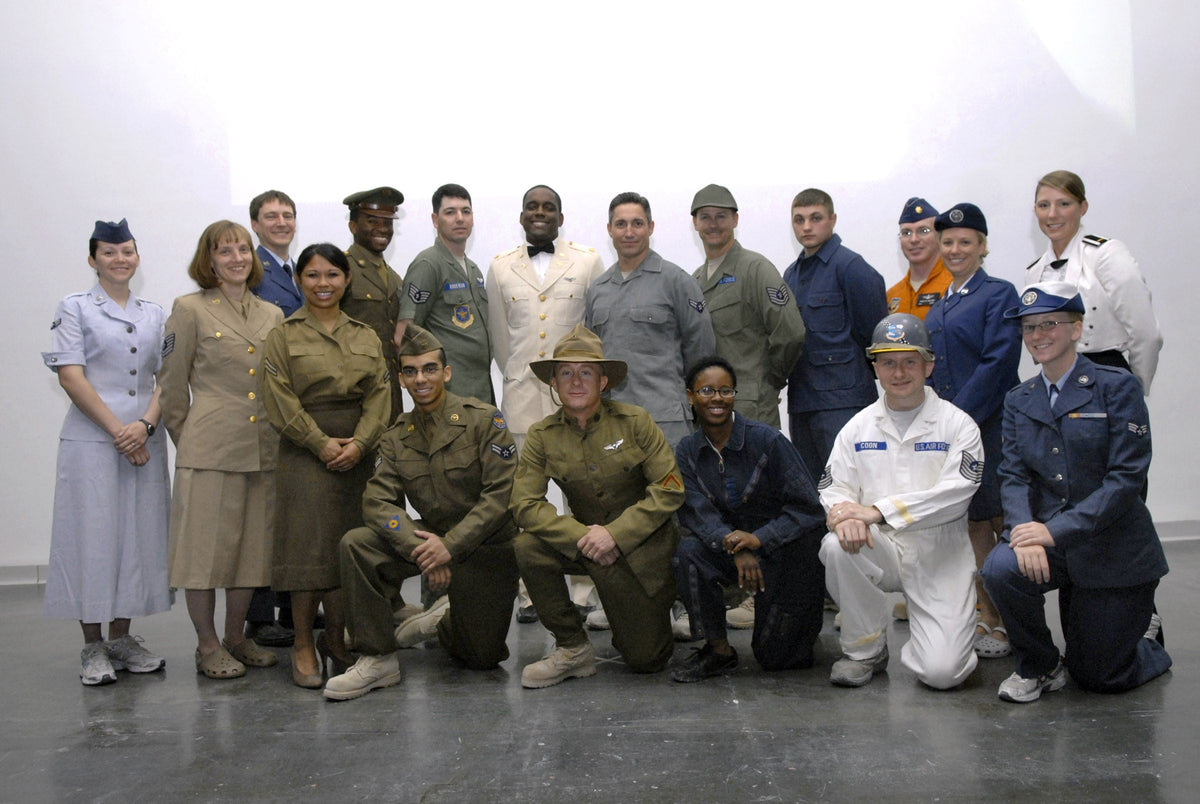
US military uniforms come in four main families: combat or utility uniforms for daily work and the field, physical training (PT) uniforms, service and dress uniforms for offices and ceremonies, and the headgear, boots and insignia that complete each one. Every branch has its own version of each, and the patterns and cuts have changed several times since the 1980s. This guide walks through each type for the Army, Navy, Marine Corps and Air Force, explains what is current and what is now surplus, and covers what civilians can wear.
The four uniform families at a glance
- Combat and utility uniforms: camouflage coats and trousers worn for daily duty, training and deployment.
- PT uniforms: shirts, shorts, jackets and pants for physical training.
- Service and dress uniforms: coats, trousers or skirts and shirts for office work, travel, formal events and ceremonies.
- Accessories: headgear, boots, belts, name tapes, rank and badges, each governed by branch regulations.
For a deeper look at how the combat uniforms changed in cut and pocket layout, see BDU vs ACU vs OCP. For the patterns themselves, see camo patterns explained.
Combat and utility uniforms
BDU (Battle Dress Uniform)
The BDU was introduced in 1981 in the four-color Woodland pattern and was worn by all the services through the 1990s. The coat has four large button-flap pockets and the trousers have a button fly, six pockets and drawstring cuffs. The Army replaced it with the ACU, finishing the switch in 2008. The Air Force and Navy kept BDUs a few years longer until their own new uniforms arrived. Today the BDU cut is a civilian staple for work, hunting and casual wear. Browse uniforms and BDUs and woodland camo.
DCU (Desert Camouflage Uniform)
A six-color desert BDU, nicknamed "chocolate chip," was worn in the 1980s and during the 1991 Gulf War. The three-color DCU replaced it in the 1990s and was worn in Iraq and Afghanistan until the ACU took over. Both use the BDU cut. Shop tri-color desert camo.
ACU in UCP (Universal Camouflage Pattern)
The Army Combat Uniform arrived in 2005 with a new cut: mandarin collar, hook-and-loop closures, angled chest pockets, shoulder pockets and knee-pad pockets. Its grey-green digital UCP pattern was meant to work everywhere but was widely criticized for blending poorly in most terrain. UCP items are still sold as ACU digital camo.
OCP (Operational Camouflage Pattern)
The Army began issuing uniforms in OCP, a pattern from the MultiCam family, in 2015, and OCP became the only authorized Army combat uniform pattern on October 1, 2019. The uniform kept the ACU name and cut, and a lighter hot-weather version followed. The Air Force and Space Force also wear OCP (see below). For a close look, browse MultiCam.
MCCUU and MARPAT (Marine Corps)
The Marine Corps Combat Utility Uniform was introduced in the early 2000s in MARPAT, a digital pattern in woodland and desert versions. The Marines were the first US service to field a digital pattern, and MARPAT is reserved for Marine use. Marines wear an eight-point utility cover with it. See Marines gear.
NWU (Navy Working Uniform)
The Navy fielded the NWU Type I, a blue and grey digital pattern, in the late 2000s. It was phased out, and since October 1, 2019 the NWU Type III, a green-brown woodland digital pattern, has been the standard working uniform ashore and in port. A desert version, Type II, is limited to certain special units. Shop Navy items.
ABU to OCP (Air Force)
The Air Force wore the BDU until it introduced the Airman Battle Uniform (ABU), a grey-tan tiger-stripe digital pattern, in 2007. In 2018 the Air Force announced it would adopt the Army's OCP uniform, and the ABU was retired on April 1, 2021. Airmen wear OCP with spice brown name tapes and "U.S. AIR FORCE." See Air Force.
Coast Guard ODU
The Coast Guard wears the Operational Dress Uniform, a dark blue utility uniform with a ball cap, rather than camouflage for most duties. Browse Coast Guard.
Flight suits
Aircrew in every branch wear one-piece, flame-resistant flight suits, the classic sage green CWU-27/P being the best known. They have zip pockets on the chest, sleeves and legs so items stay secure in the cockpit. Civilian-made flight suits and coveralls are popular for mechanics, pilots and costumes. Browse pilot and coveralls.
Field jackets
The M-65 field jacket, adopted in 1965, has a stowaway hood in the collar, four front pockets and a button-in liner. It was worn over the utility uniform through Vietnam and well into the BDU era, and remains one of the most copied military jackets. See the M-65 field jacket guide and jackets and coats. Modern cold-weather layers follow the ECWCS system covered in the cold weather layering guide.
PT (physical training) uniforms
- Army IPFU: the Improved Physical Fitness Uniform of the 1990s and 2000s, with grey T-shirts, black shorts and a grey and black nylon jacket and pants.
- Army APFU: the Army Physical Fitness Uniform, black and gold, which replaced the IPFU in the mid-2010s. Full details are in the Army PT uniform guide.
- Navy PT: navy blue shorts and a gold shirt with "NAVY," plus a navy running suit.
- Marine Corps PT: olive drab T-shirt and green shorts, with a green and gold running suit.
- Air Force PT: dark blue shorts and grey or blue shirts with reflective "AIR FORCE" lettering.
For training at home, plain T-shirts and tank tops and shorts in the same colors work well.
Service and dress uniforms
Army: ASU and AGSU
For decades the Army wore the Army Green Class A uniform. The blue Army Service Uniform (ASU) replaced it in the late 2000s and became mandatory in 2015. In 2020 the Army began issuing the Army Green Service Uniform (AGSU), modeled on the World War II officer uniform known as "pinks and greens": a dark olive coat, drab trousers, a tan shirt and brown leather shoes. The AGSU is the everyday business uniform, with a mandatory possession date planned for 2027, and the blue ASU is now the formal dress uniform.
Navy: service dress blues and whites
Navy service dress blues are worn in cooler months and service dress whites in warmer months. Junior enlisted sailors wear the traditional jumper style with a neckerchief and the white "Dixie cup" hat; chiefs and officers wear a coat and tie with a combination cover. For daily office work, sailors wear the Navy Service Uniform or khakis, depending on rank.
Marine Corps: dress blues and service uniforms
Marine Blue Dress, with its dark blue high-collar coat, white cover and blue trousers with a red stripe for NCOs and officers, is one of the most recognized uniforms in the world. The green Service uniform (Alphas, with coat; Bravos and Charlies, with shirt only) is the daily business uniform.
Air Force and Space Force: service dress
The Air Force service dress is a blue three-button coat, light blue shirt, tie and blue trousers or skirt, with a flight cap or service cap. The Space Force has been introducing a service dress of its own with distinct insignia.
Headgear
- Patrol cap: the soft, flat-topped cap worn with the Army and Air Force OCP uniform, and before that with the ACU and BDU. See patrol and fatigue caps.
- Boonie hat: a wide-brimmed field hat, authorized in the field and deployed settings. See boonie and bucket hats.
- Beret: the Army black beret, the tan beret of the Rangers, the green beret of Special Forces, the maroon beret of airborne units, plus Air Force colors for Security Forces and special warfare career fields. See beret colors and their meaning and berets.
- Garrison cap: a folding cap without a brim, worn with service uniforms by the Air Force, Navy, Marines and, since the AGSU, the Army.
- Service cap: the peaked "bus driver" style cap worn with dress and service uniforms. See military service hats.
- Cold weather: fleece and knit watch caps in approved colors. See beanies and watch caps.
Boots
Under AR 670-1, Army boots worn with the OCP uniform are coyote brown, made of rough-side-out leather or leather and fabric, with a rubber sole and no shine. The black polished boot belongs to the BDU era, when spit-shined black leather was the standard. The Air Force also wears coyote brown boots with OCP; the Navy wears brown boots with the NWU Type III; Marines wear their own coyote and tan boots. Items made to the Army rule are gathered in the AR 670-1 collection. For fit and break-in, read the military boots buying guide, then browse boots.
Insignia and rank basics
Every uniform carries a few standard identifiers:
- Name tape and service tape: on the OCP coat, the wearer's last name goes over the right chest pocket and the branch name over the left. On the BDU, the tapes sit above the matching pockets.
- Rank: on the OCP coat, rank is a single patch or pin-on centered on the chest. On service uniforms, enlisted rank goes on the sleeves and officer rank on the shoulders or collar.
- Unit patches: the left shoulder carries the current unit, and soldiers who have served in combat with a unit may wear its patch on the right shoulder.
- Flag: the US flag patch is worn on the right shoulder, reversed so the stars face forward.
- Badges and tabs: qualification badges such as Airborne or Air Assault, and tabs such as Ranger or Special Forces, are earned through training.
Rank runs in three groups across all services: enlisted (E-1 to E-9), warrant officers (W-1 to W-5, not used by the Air Force) and commissioned officers (O-1 to O-10). Each branch names and marks the grades its own way. Shop patches and insignias, medals and ribbons, and read how to wear and care for BDUs for patch and name tape placement on older uniforms. Dog tags are covered in the military dog tags guide.
What civilians can wear
Wearing military surplus and military-style clothing is common and legal in the US. Camo pants, field jackets, boots, PT shirts and caps are everyday clothing for workers, hunters, campers, students and collectors. A few lines are worth knowing:
- Federal law restricts wearing a US armed forces uniform without authority, and impersonating a service member to deceive people is a crime. Plain surplus or styled clothing worn as everyday clothes is not the concern.
- The Stolen Valor Act makes it a federal crime to falsely claim certain military decorations in order to obtain money, property or other benefits.
- Out of respect and to avoid confusion, civilians should leave off rank, unit patches, qualification badges, tabs and medals they did not earn.
- Theater, film, reenactments and costumes are a long tradition; keep them clearly in that context.
- Veterans may wear certain uniform items and medals on some occasions under their branch's rules.
This is a general overview, not legal advice. If you are unsure, keep the uniform plain. To understand what you are buying, read Genuine G.I. surplus vs military-style and browse genuine military surplus.
Comparison table
| Uniform | Branch | Type | Era | Pattern or color |
|---|---|---|---|---|
| BDU | All services | Combat/utility | 1981 to about 2008 (Army) | Woodland |
| DCU | All services | Combat/utility | 1990s to mid-2000s | Three-color desert |
| ACU (UCP) | Army | Combat/utility | 2005 to 2019 | Grey-green digital |
| ACU (OCP) | Army | Combat/utility | 2015 onward, sole pattern from 2019 | OCP |
| MCCUU | Marine Corps | Combat/utility | Early 2000s onward | MARPAT woodland and desert |
| NWU Type I | Navy | Working | Late 2000s to 2019 | Blue and grey digital |
| NWU Type III | Navy | Working | Standard from 2019 | Woodland digital |
| ABU | Air Force | Combat/utility | 2007 to 2021 | Grey-tan digital tiger stripe |
| OCP | Air Force, Space Force | Combat/utility | 2018 to 2021 transition onward | OCP |
| Flight suit | All aircrew | Flight | Decades, ongoing | Sage green, tan |
| M-65 | All services | Field jacket | 1965 onward | Olive drab, later camo |
| APFU | Army | PT | Mid-2010s onward | Black and gold |
| ASU | Army | Dress | Late 2000s onward | Dark blue |
| AGSU | Army | Service | 2020 rollout onward | Dark olive and drab |
| Service dress blues/whites | Navy | Dress | Ongoing | Navy blue, white |
| Blue Dress | Marine Corps | Dress | Ongoing | Dark blue, white cover |
How to choose for your use
- Serving members: buy only what your branch regulation authorizes, in the current pattern, and check the label before you wear it on duty.
- Work and outdoors: the BDU cut in woodland, olive or khaki is tough and roomy. For duty roles such as police, security or EMS, see the work and duty uniforms guide and the security guard uniform checklist.
- Fit: use the BDU pants size guide before ordering trousers.
- Collectors and reenactors: match the era carefully: woodland BDUs with black boots, UCP with tan boots, OCP with coyote brown.
- Gifts: shop the Army collection and military and veterans section for branch-themed items.
Frequently asked questions
What uniform does the Army wear today?
The Army Combat Uniform in OCP for daily duty and the field, the Army Green Service Uniform for business and service settings, the blue Army Service Uniform for formal dress and the black and gold APFU for physical training.
When did the Army stop wearing BDUs?
The ACU was introduced in 2005 and the Army completed the change from the BDU by 2008. Other services kept BDUs a little longer until their own uniforms were fielded.
Does the Air Force wear the same uniform as the Army?
For the combat uniform, largely yes. The Air Force adopted the OCP uniform starting in 2018 and retired the ABU in 2021. Airmen use their own tapes, rank and some different accessories, and keep their own service dress and PT uniforms.
What are "pinks and greens"?
The nickname for the World War II Army officer uniform, a dark olive coat with lighter trousers that looked pinkish in some light. The Army Green Service Uniform, issued from 2020, is based on it.
What color boots does the military wear now?
Coyote brown for the Army and Air Force OCP uniforms, brown for the Navy working uniform and coyote or tan for Marines. Black polished boots are mostly worn with dress uniforms or older uniforms.
Can civilians wear military uniforms?
Wearing surplus and military-style clothing as everyday wear is legal and common. Do not wear rank, medals, badges or patches you have not earned, and never use a uniform to pass yourself off as a service member.
What is the difference between OCP and MultiCam?
OCP is based on the MultiCam family and looks very similar, but its colors and details differ, so the two are not identical. Gear in either usually pairs well.
Find the uniform pieces you need in clothing.